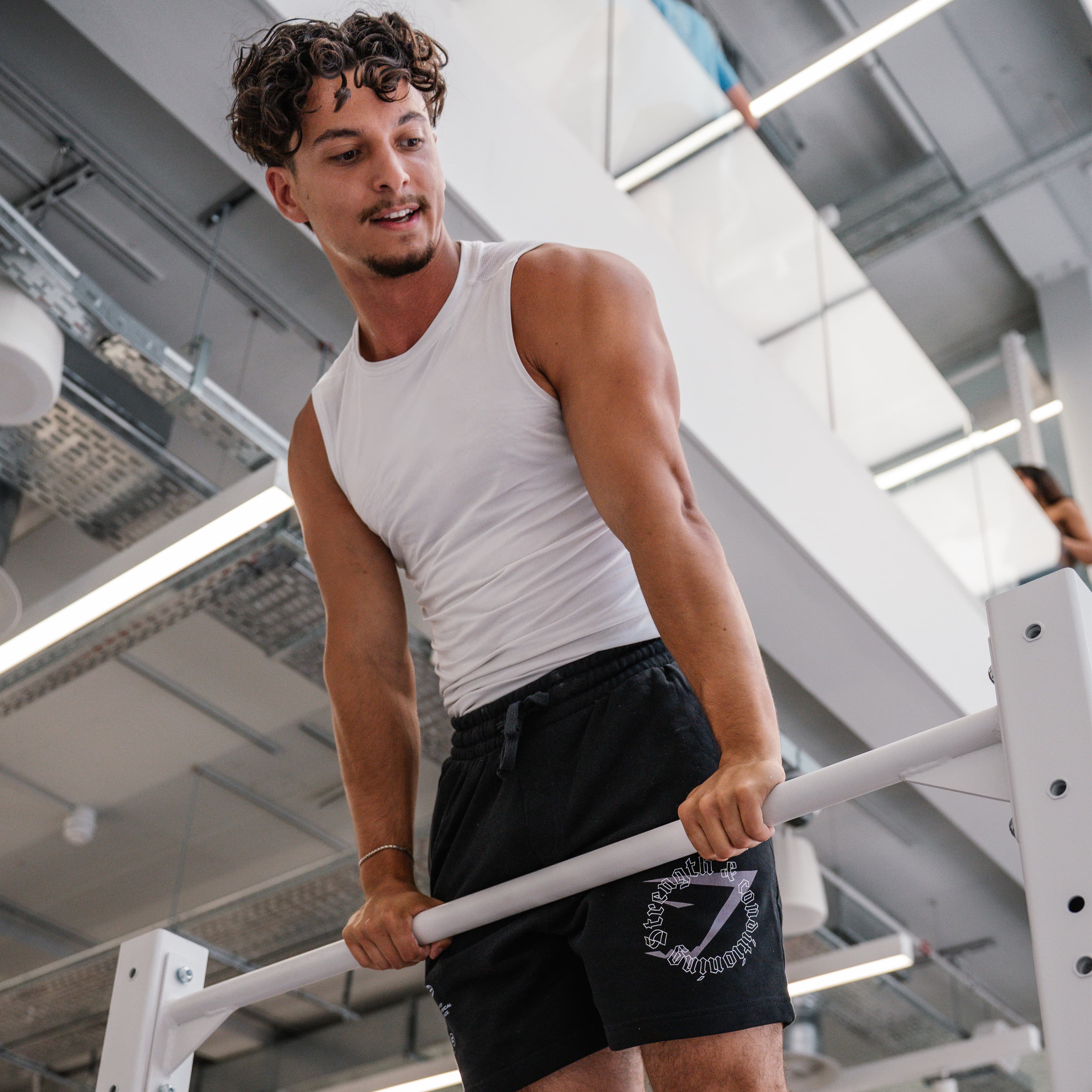



















Join any functional fitness class, and they’ll likely take you through a series of dynamic stretches before getting into the actual session.
But let’s not sugarcoat anything here: Most of us would rather not spend time stretching (even if it is dynamic stretching, which is arguably slightly more interesting than static stretches).
Maybe you feel it’s a waste of time. Maybe you ‘don’t have time’. Maybe you just find it boring.
Whatever your reason, you aren’t alone if you’ve skipped your pre-workout dynamic stretching in favor of securing your most needed piece of equipment before the gym gets busy.
So, are you missing out? We’re here to show you why doing dynamic stretches might be a good idea (and also weigh up why skipping them might not be as detrimental as you think).
If you decide dynamic stretches are for you, we’ve also gathered the best dynamic stretching examples that will help you get the most from your session.
Disclaimer: Just like static stretches, dynamic stretching is a hotly debated topic, with theories surrounding why and when you should do them. Taking studies into account (and drawing from the knowledge of our inhouse experts) we’ve weighted up both sides of the argument to draw our own conclusions.
What Is Dynamic Stretching?
Dynamic stretching is defined as a controlled movement through the active range of motion for each joint–in other words, it’s the form of stretching where you move through a series of movements [1].
It is stretching, but it’s different from the slow-paced stretching you often skip at the end of your workout (yes, we see you 👀). While static stretches involve positions held for periods of time, dynamic stretching is stretching in its active form, making it ideal for warming up the body, increasing blood flow, and improving ROM (range of motion).
Is Dynamic Stretching Good for You?
The all-important question. To help you make your own decision, we’ve weighed up the benefits and drawbacks of dynamic stretching.
Unlike static stretching, research has concluded that dynamic stretching will not negatively impact your workout (as long as you keep your pre-workout stretch routine short) and is generally considered safer than static stretching.
Research has also found benefits to dynamic stretching pre-workout, including promoting blood flow, improving range of motion, possibly reducing injury, and even enhancing performance.
However, other research has questioned its ability to reduce injury rate and warned that dynamic stretching could impact exercise performance if done for too long.
What Are The Benefits Of Dynamic Stretching?
Promotes Blood Flow And Raises Heart Rate
Guilty of sitting at your desk all afternoon? Moving through dynamic stretches brings increased blood and oxygen to the muscles, priming them for exercise.
Could Reduce Injury Rate
The FIFA 11+ trial in 2022 concluded that incorporating dynamic, sport-specific exercises into warm-up programs can significantly enhance injury prevention and performance in youth football players [2]. However, some research disagrees–more on that below.
Improves Range Of Motion
A 2019 study of 24 participants found that those who performed 15 reps of a knee extension and relaxation movement (to stretch the hamstrings) before exercise increased the range of motion in the hamstrings by seven to 10% and decreased overall stiffness [3].
Safer Than Static Stretching
As dynamic stretching only moves the body through the active ROM, it is often considered a safer type of exercise than static stretching, which pushes you to reach full ROM.
While many seek to improve their flexibility, it’s actually mobility (building strength through your current ROM) that is more important for injury prevention since injuries most commonly occur when the muscle is stretched eccentrically, when the force applied to the muscle exceeds the force the muscle can produce [4].
Doesn’t Negatively Impact Performance
Due to the above, many researchers agree that, unlike static stretching, dynamic stretching doesn’t negatively impact speed, agility, or strength [5,6].
Could Improve Performance
Some research concludes that dynamic stretches pre-workout can actually improve athletic performance and strength (even when no dedicated strength training is performed!) [7]. However, further studies conclude that this improvement is likely only small.
Gets You ‘In The Zone’
How many times have you stepped onto the gym floor, and an email or task from work is still buzzing around in your head? Taking some time at the start of your session can be a great way to prep your brain for your workout and prepare to give it your best. Don’t just take our word for it–studies have proven that dynamic stretching enhances neuromuscular function, signaling to your brain that your muscles are ready to go [8].
Just like the narrative surrounding static stretches, dynamic stretches have been pulled up for some flaws (again, these are contested, but these are what some researchers conclude):
What Are The Drawbacks Of Dynamic Stretches?
Dynamic Stretching May Not Reduce Injury Rate
While some studies (as above) claim static stretches effectively reduce injury risk, others, such as this 2014 review, concluded that stretching did not reduce injury at all in participants [9]. It’s worth noting that this was a large study evaluating the results of 26,000 people who had experienced 3,500 injuries, heightening its validity.
Could Impact Workout Performance If Done For Too Long
Spend too long stretching dynamically before your workout, and you risk fatiguing your body before you start your workout. Two studies have proven this, with the first finding that only an 8-minute dynamic warm-up improved soccer players' performance, while a 25-minute warm-up decreased performance [11].
Another study found that 1 to 2 sets of 20 m of active dynamic stretches in a warm-up enhanced athlete sprint performance, while three sets induced fatigue and impaired performance [1].
May Not Reduce DOMS
We’ve all had that workout where we’ve woken up the next day and struggled to climb the stairs or sit down. Unfortunately, no evidence suggests that dynamic stretching can reduce delayed-onset muscle soreness (DOMS).
You’re best sticking to post-workout static stretches, a good foam roll, or an ice bath if you have one! Make sure you are also getting enough protein in for recovery and prioritize sleep.
So Do You Need To Do Dynamic Stretches?
Well, as long as you don’t do them for too long, evidence suggests there is no harm in doing dynamic stretches as part of a warm-up.
But do you have to do them? Probably not.
Sports Therapist Samantha Banks explains that ‘you can actually use the first few sets of your lift to get warm instead of doing dynamic stretches. For example, if you’re squatting or benching, use just the barbell to practice getting to full depth and gradually increase the weight as your muscles warm up. If you're doing Olympic lifting, you might follow a specific clean or snatch warm-up rather than dynamic stretching.’
‘If you enjoy dynamic stretching and feel like it sets you up for your workout, then do it. If not, then don’t do it.’
Another option is to use dynamic stretching between the first few sets of your first exercise. That way, you’re still activating the required muscle groups, promoting blood flow, and improving mobility without feeling like you’re spending a ton of time warming up at the start of your workout.
Dynamic Stretching Examples to Try
If you’ve decided to add dynamic stretching to your routine, you’ll want the exercises that give you the best bang for your buck.
Remember: When selecting dynamic stretches, always consider the exercises or movements you are going to do in your main session. We’ve broken these dynamic stretches down into upper body, lower body, and full body to make it easy.
Upper Body Dynamic Stretches
Lower Body Dynamic Stretches
Full Body Dynamic Stretches
Upper Body Dynamic Stretches
Shoulder Dislocates
As one of the most commonly injured joints, it’s extremely important to warm the shoulder joint up before exercise [11]. Whether you’re a lifter training overhead press, a weightlifter practicing snatches, or a baseball player throwing a powerful bowl, priming your shoulder with an exercise such as shoulder dislocates to increase mobility can reduce the risk of strains, impingements, or tears.
This exercise will also improve scapular stability (the ability to keep the shoulder blades stable while moving the arms), which is crucial for pressing or throwing exercises.
How To Do Shoulder Dislocates:
Take hold of a PVC pipe, a long resistance band, or another object. Hold it in a wide grip with both hands, knuckles facing down. Stand with your feet shoulder-width apart.
Keeping your arms straight, lift the object up and over your head, moving it towards your back. Keep your elbow straight throughout, aiming to touch your back with the object (although you should only go as far as comfortable). Keep your core brace and pelvis tucked, ensuring your ribs do not flare.
Pause, then pass the object back over your head, returning it to the front of your thighs.
Repeat for 10 to 12 reps, keeping the movement slow and controlled and focusing on feeling the stretch through your chest, shoulders, and upper back.
Tip: If your shoulders feel tight, don’t push the object further behind your head than comfortable. Start with a wider grip; as your mobility improves, you can bring your grip closer together to make the exercise harder.
Scapular Push Ups
Scapular push ups are ideal before any upper-body workout, particularly those involving pushing or pulling movements. They help activate the muscles responsible for stabilising the shoulder joint, preparing the body for exercises like bench presses, overhead presses, pull-ups, and rows.
They are also ideally suited as a primer for any sports that significantly use the shoulder joint, from swimming to tennis, basketball to volleyball. Strengthening the shoulder stabilising muscles reduces the risk of shoulder impingement or strain.
How To Do Scapular Push Ups:
Come into a high plank position; hands shoulder-width apart and directly below shoulders. Turn your fingers out slightly (thinking about screwing the palms of your hands into the ground). Ensure your body forms a straight line from head to heels. Brace your core and squeeze your glutes.
Keeping your elbow straight, retract your shoulder blades, pinching them together, letting your body sink.
Once your shoulder blades are retracted as far as they can go, pause, then press yourself back up, pushing through your palms to create a rounding in the upper back.
Hold for a second, then repeat for 10 to 15 reps.
Tip: Focus on holding both the retracted and the protracted positions for a second each time. Ensure your elbow stays straight throughout to maximise work through the shoulder blades. Avoid dropping the hips, keeping your glute squeeze throughout to maintain a straight line from head to heels.
Other Upper Body Dynamic Stretches:
Thread The Needle (Benefits: Stretches the thoracic spine and enhances flexibility in the chest and shoulders, this dynamic stretch is ideal for warming up before exercises or sports that involve upper-body twisting, shoulder mobility, or a need for thoracic spine flexibility such as yoga, swimming or tennis.)
Banded Pull-Aparts (Benefits: Activate the upper back and shoulders, improving scapular stability. They are ideal for overhead movements such as thrusters, overhead press and pull-ups.)
Banded Shoulder External Rotation (Benefits: Strengthens and mobilises the rotator cuff muscles, helping with shoulder stability and preventing injuries. Similar to banded pull-apart, these are well suited to doing before the overhead movement that requires shoulder stability.)
Wall Angels (Benefits: Improves shoulder mobility and engages the upper back, glutes, and core for better posture. Suited to any activity that involves overhead movements or requires strong scapular stability and upper back mobility.)
Lying Y-T-W (Benefits: Improves shoulder mobility and enhances scapular stability. Similar to the above, they are a good warm-up for overhead exercises and sports such as swimming and boxing.)
You might like: The Best Shoulder Stretches To Improve Shoulder Mobility
Lower Body Dynamic Stretches
Leg Swings
Whether you’re heading to the squat rack, lacing up for a run, or wall balls are on the cards, leg swings are a great dynamic exercise to loosen the hip joint and improve mobility, useful for any lift or exercise requiring mobility and stability of the hips.
You’ll also engage the hamstrings, glutes, quads, and core, warm up key muscle groups to prepare you for your session, and test your coordination and balance (although we suggest holding on to something secure for these!).
How To Do Leg Swings:
Find something secure to hold onto. We suggest the squat rack or rig (but if you fail to do this, you can use a wall). Stand side-on to your supporting object with feet hip-width apart. Place the hand nearest the rack or rig onto it, taking a firm grip.
Stand tall and brace your core. Swing one leg forward (kicking only as high as comfortable), keeping it straight or slightly bent. Then, swing it back behind you, allowing a gentle stretch (but avoiding overextending your lower back).
Repeat for 10 to 15 reps, then switch legs.
Tip: Don’t put too much force through the swing. Keep the movement controlled, and don’t overswing.
Bootstrapper Squats
Bootstrappers (or squat to stand) are our favourite pre-squat dynamic stretch. They mobilise the hip flexors, ankles, and hamstrings and reinforce proper squat mechanics and depth.
To save time, you could even perform these in between the first few warm-up sets of your first exercise, making your warm-up time efficient and specific.
How To Do Bootstrappers:
Stand with feet shoulder-width apart, toes pointing slightly out.
Come down to the bottom of a deep squat (think ass to grass here!).
Move your arms between your knees and your fingers under your toes. Keep your chest up and back straight, elbows pressing lightly against the insides of your knees to help open your hips.
Lift your hips, straightening your legs as much as possible, bringing your chest toward your thighs.
Feel the stretch in your hamstrings, then drop back into the deep.
Continue alternating between deep squats and hamstring stretches for 8 to 12 reps.
Tip: If you find yourself struggling to get to depth in the bottom of your squat or straighten your legs during the hamstring stretch, don’t force it. Only go as low as your mobility allows, and gradually, over time, your mobility will increase with practice.
Other Lower Body Dynamic Stretches Include:
Walking Lunges (Benefits: Improves hip mobility, Enhances Balance and Stability, and engages key muscle groups such as quads, hamstrings, glutes, and calves use compound lower body lifts.)
Cossack Squats (Benefits: Improves lateral hip and groin flexibility and strengthens the inner thighs and glutes. Particularly suited to warming up for weightlifting, martial arts, basketball, or soccer, where deep squatting, lateral movements, or explosive leg work are involved.)
Hip Circles (Benefits: Loosens up the hip joints and improves overall hip mobility. Well suited for improving stride length and running mechanics.)
High Knees (Benefits: Increases heart rate and blood flow to the lower body, activating the glutes, hamstrings, hip flexors, and calf muscles, making them a great pre-run dynamic movement.)
Lateral Leg Swings (Targets the adductors (inner thighs) and abductors (outer hips) to improve hip mobility–making them ideal pre-squat or deadlift primer)
Full Body Dynamic Stretches
World’s Greatest Stretch
Considered one of the most effective full-body dynamic stretches, stretching multiple major muscle groups: If you pick one dynamic stretch to do, let it be the world’s greatest stretch. The lunge will activate your glutes, hamstrings, quads, and calves while moving your elbow to touch the floor and rotating towards the sky will stretch the muscles in your upper back as well as the pecs, shoulders, obliques, and more.
If you’ve been sitting at a desk all day, this is a great movement to release any pent-up tension in your back, improve posture, and enhance thoracic spine mobility.
How To Do The World’s Greatest Stretch:
From a standing position, step into a forward lunge with your right leg, bringing the left knee down to the ground and setting your front foot at a slight diagonal (45-degree) angle.
With your left hand on the ground in line with your right ankle, lift your left knee off the ground, making sure your back leg is straight. Squeeze your glutes and ensure your hips stay low.
Bring your right elbow towards your right ankle, touching it as close to your ankle as possible.
Then, rotate your torso towards your right leg, reaching your right arm towards the ceiling. Look up towards your raised hand, feeling the stretch in your spine and chest.
Pause for a second, then reverse, bringing your right elbow back towards your ankle.
Once you have completed 6 to 10 reps, repeat on the other side.
Tip: Avoid rushing this exercise. Instead, focus on keeping the movement slow and smooth, with a full reach up and driving your elbow down towards your ankle to maximize ROM.
Inchworms
Inchworms are a versatile dynamic stretch, well suited as a warm-up for compound lifts, push/pull exercises, and full-body functional exercises. They activate multiple major muscle groups and develop core, shoulder, and wrist stability, which is important for many pushing and pulling movements.
If you're warming up for a sport, inchworms improve the hamstring and calf flexibility required for sports such as soccer and athletics, as well as the upper body stability required for racket sports.
How To Do Inchworms:
Stand tall with feet hip-width apart, arms by your side.
Hinge at the hips, pushing your bum back and reaching your hands towards the ground. Aim to touch the floor in front of your feet, keeping your legs straight as possible (although a slight bend at the knees is fine if your hamstrings are tight).
Walk your hands forward one by one until your body is in a high plank position with your hands and wrists stacked directly below your shoulders. Brace your core, keep your back straight, and squeeze your glutes.
Pause for a second, then walk your feet towards your hands, aiming to keep your legs as straight as possible while bringing your feet as close to your hands as possible.
Once your feet are as close as you can get them, stand up and repeat for 6 to 10 reps.
Tip: To protect your lower back, it’s important to brace your core throughout the movement. Avoid rushing, instead performing inchworms in a controlled manner to stretch the muscles fully.
Other Full Body Dynamic Stretches:
Cat Cow Stretch (Benefits: Help mobilise the spine, activate the core, and improve posture, ensuring better form during lifts. Cat cow is also good for preparing the body for the repetitive motions of running and can be especially helpful for relieving any stiffness in the lower back before a run.)
Walking Lunge With Twist (Benefits: Combines lower-body activation with spinal rotation, making it an excellent warm-up for weightlifting, running, or tennis.)
Reverse Lunge With Reach (Benefits: Combines lower-body activation with an upper-body reach, improving balance, flexibility, and strength. It's ideal for any sport or workout that requires stability, coordination, and functional movement.)
Bear Crawls (Benefits: Engages the entire body, particularly the core, and boosts shoulder stability. It’s well suited to warming up for high-intensity functional exercises such as
kettlebell swings, burpees, and wall balls, where core stability, shoulder strength, and full-body coordination are essential.)
Spiderman Stretch: (Benefits: Targets the hips, hamstrings, quads, groin, and thoracic spine, making it ideal for warming up for exercises or sports that require hip mobility, leg flexibility, and thoracic spine rotation, such as weightlifting, running, or tennis.)
Dynamic Stretching: Is It Worth It? The Verdict
Carve out a bit of time at the start of your workout for dynamic stretches, and you will get the blood flowing through your muscles, improve your range of motion, and get yourself into the workout headspace. You may also reduce your risk of injury and improve your performance. To put it simply: Keep to a short and sweet routine, dynamic stretches at the start of your workout shouldn’t do any harm.
Skip dynamic stretches, and – well, it may not be as bad as you first thought.
Sometimes, a few minutes on a cardio machine, heading straight to your first exercise, and warming up with a light weight is all you need.
You could also perform dynamic stretches between your warm-up sets to work on your mobility without feeling like you’re spending a chunk of time at the start of your session before you even get to the good stuff.
All in all, the jury is out on how essential dynamic stretches actually are: But if you feel better, more prepared for your session, and more mobile afterward, then it’s probably a worthwhile activity (but don’t beat yourself up if this isn’t the case!).
To stretch or not to stretch? The choice is in your hands.
FAQs
How Often Do I Need To Do Dynamic Stretches?
Research recommends dynamic stretches be done at least twice a week–but you could actually do them more or less than this [12]. As mentioned, you might not find you benefit from dynamic stretches and find warming up with a light weight during your first compound lift sufficient. Or, you might use dynamic stretches in your pre-workout ritual for every session. Really, the choice is up to you and how your body feels.
When Is The Best Time To Do Dynamic Stretches?
Dynamic stretches aren’t essential–but if you decide to do them, you should do them before your workout.
Here is how you could structure your warm up if you included dynamic stretches:
Start with some cardio to increase your heart rate and blood flow to the muscles. That could be jumping on a cardio machine or doing bodyweight exercises such as jumping jacks, squat jumps, or down-ups.
Then, choose a few dynamic stretches to do.
Finally, if necessary, perform some sport-specific movements. These might include plyometric exercises before running or warming up on the barbell before your compound lifts.
We would note that your dynamic stretches should always be specific to the workout or sport you are about to do. Think about the muscles you will use in your workout or the movement patterns you’ll be using, and choose the correct dynamic stretches to complement your session.
Looking for the perfect leg day warm-up? We’ve got you covered.
How Long Should I Stretch For?
Luckily, shorter is better when it comes to dynamic stretching. Keep your dynamic stretches to 7 to 10 minutes max [12].
Is Dynamic Stretching Better Than Static Stretching?
Dynamic stretches are fluid, using movement to mimic the exercises (or sports) you are about to do. Static stretches, on the other hand, see you hold a position for a period of time.
When it comes to warming up, dynamic stretching is the clear winner. They have been proven to improve blood circulation, increase range of motion, possibly elevate subsequent workout performance and reduce the risk of injury (although there is still some dispute regarding the latter two benefits).
Static stretching, however, is not recommended before your workout (and some studies have even shown it to harm workout performance!). Other studies even go further to conclude that even post-workout, static stretches do little to help recovery.
Curious to find out more? Read our article on Dynamic Vs Static Stretching, where we delve into the difference between the two and the arguments for and against each stretching type.
References:
Turki, O., Chaouachi, A., Behm, D.G., Chtara, H., Chtara, M., Bishop, D., Chamari, K. and Amri, M. (2012). The Effect of Warm-Ups Incorporating Different Volumes of Dynamic Stretching on 10- and 20-m Sprint Performance in Highly Trained Male Athletes.
Asgari, M., Alizadeh, M.H., Shahrbanian, S., Nolte, K. and Jaitner, T. (2022). Effects of the FIFA 11+ and a modified warm-up programme on injury prevention and performance improvement among youth male football players.
Iwata, M., Yamamoto, A., Matsuo, S., Hatano, G., Miyazaki, M., Taizan Fukaya, Fujiwara, M., Asai, Y. and Suzuki, S. (2019). Dynamic Stretching Has Sustained Effects on Range of Motion and Passive Stiffness of the Hamstring Muscles.
Eirale, C. and Ekstrand, J. (2019). Aspetar Sports Medicine Journal - Hamstrings Are Dangerous For Sport And Sport Is Dangerous For Hamstrings.
Wong, D.P., Anis Chaouachi, Lau, P.W. and Behm, D.G. (2011). Short Durations of Static Stretching when Combined with Dynamic Stretching do not Impair Repeated Sprints and Agility.
Warneke, K. and Lohmann, L.H. (2024). Revisiting the stretch-induced force deficit: A systematic review with multilevel meta-analysis of acute effects.
Rubini, E.C., Costa, A.L.L. and Gomes, P.S.C. (2007). The Effects of Stretching on Strength Performance
Wang, B., Wu, B., Yang, Y., Cai, M., Li, S. and Peng, H. (2024). Neuromuscular and balance adaptations following acute stretching exercise: a randomized control trial.
Lauersen, J.B., Bertelsen, D.M. and Andersen, L.B. (2014). The effectiveness of exercise interventions to prevent sports injuries: a systematic review and meta-analysis of randomised controlled trials.
Yanci, J., Iturri, J., Castillo, D., Pardeiro, M. and Nakamura, F.Y. (2019). Influence of warm-up duration on perceived exertion and subsequent physical performance of soccer players.
Cleveland Clinic. (n.d.). What’s a Shoulder Sprain? [online] Available at: https://my.clevelandclinic.org/health/diseases/shoulder-sprains.
Sople, D. and Wilcox, R.B. (2024). Dynamic Warm-ups Play Pivotal Role in Athletic Performance and Injury Prevention.