


















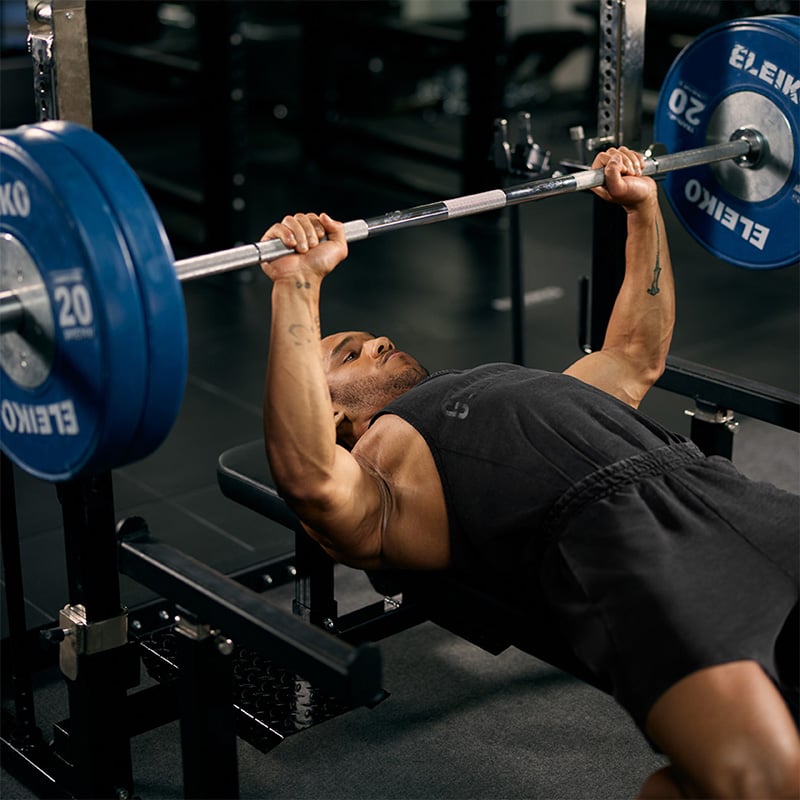
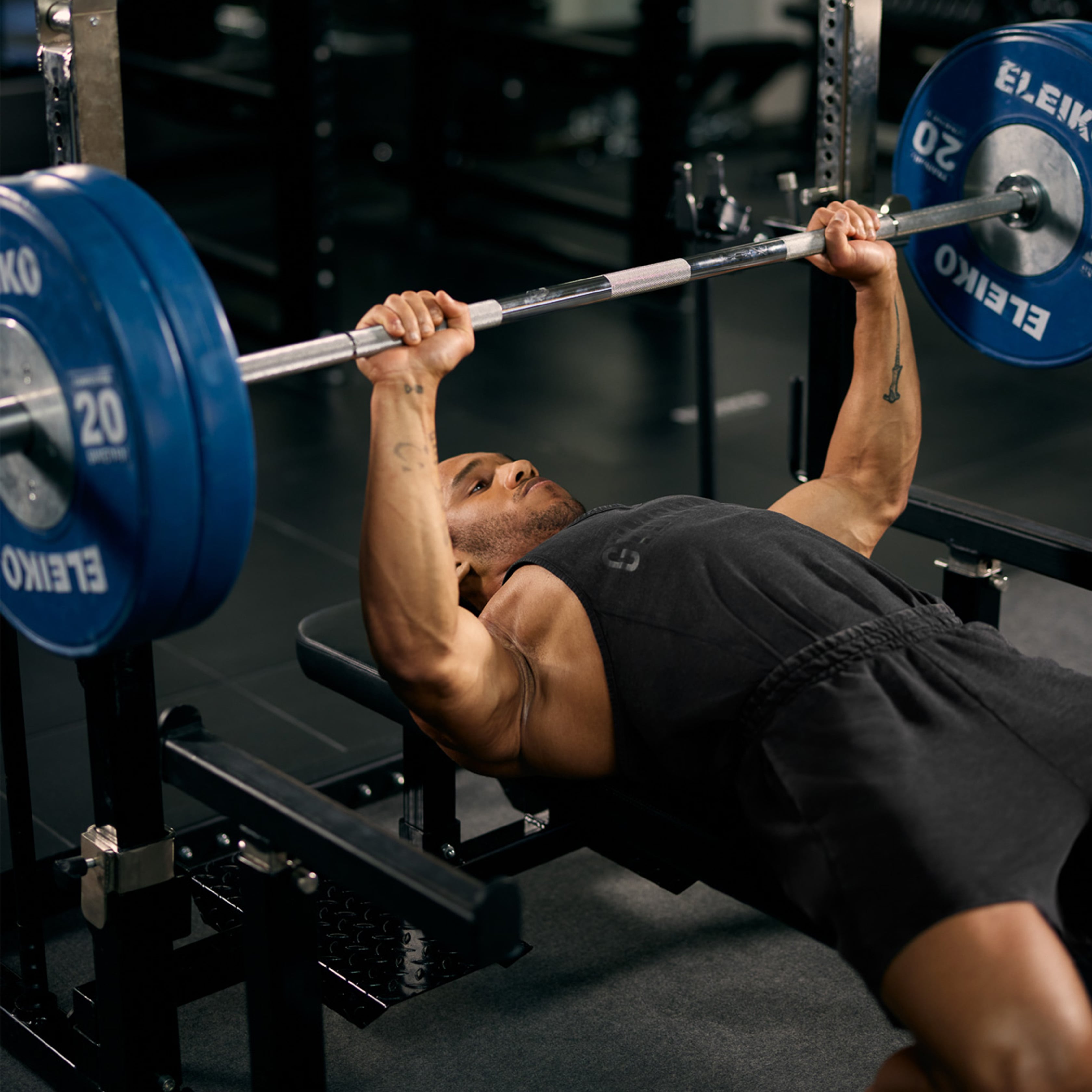
Some count down the days until they can bench again; others reluctantly sprinkle some chest exercises throughout their weekly workout split; But love it or hate it, chest exercises are something everyone should be doing.
Many dream of building a chest like CBum (or simply building a sculpted upper body), but despite what you may think, training the chest isn't just for the bro-splitters—and it’s not just for aesthetics.
A strong chest is essential for good posture (especially if you’re putting in time to train your back and spend a large part of your day desk-bound).
It’s also the secret to building strength in some of the best (but often most challenging) movements, from bench press to pull-ups.
Whatever group you fall into, one thing’s for sure: You want to train your chest in the most time-efficient, effective way possible–and we know how.
We’ve put together the ultimate chest workout guide, sharing the secrets of the best chest exercises that target every part of the chest. Get ready to lift heavy and build chest strength, size, and power.
Don’t let your hard work go unseen: Get yourself a muscle-fit t-shirt or a minimal sports bra to show off your chest gains.
What Are the Best Chest Exercises to Build Your Chest?
If you’re wondering how to build your pecs, the best chest workouts focus on working all three chest areas (upper, middle/inner, and lower), using different movement planes to create a fuller, more defined chest.
These are the:
Sagittal plane (Forward and Back Pressing Movements), e.g., flat bench press, push-ups, incline bench press. Bench angle changes, which part of the chest is emphasised with flat pressing, hitting the middle/lower chest, incline pressing, working the upper chest with greater shoulder activation, and decline pressing, activating the lower chest [1].
Frontal plane (Horizontal Abduction/Adduction): e.g., cable flies, dumbbell flies, pec deck machine. These stretch and contract the chest fibres (particularly the mid-chest) to develop chest thickness.
Transverse Plane (Rotational Movements): e.g., rotational pressing or fly variations, and twisting push-ups. Depending on the rotation, these movements engage stabilising chest fibres in different parts of the pecs.
Luckily, our best chest exercises consider this, giving the perfect balance of exercises to work each part of the chest and from different angles. Add these to your chest day workout routine, and the results start to speak for themselves.
1. Barbell Bench Press
Primary Target: Inner Chest
Movement Plane: Sagittal
Starting with the barbell bench press, one of the best and most well-known chest exercises.
Not only is the bench press a great chest builder, but building strength in this movement is one of the biggest ego boosts out there. Nothing beats loading up those 45lb plates, moving under the bar, and pressing them easily. And nothing earns you much more respect in the lifting world, either.
The flat bench barbell chest press is a great inner chest workout, but it also recruits muscle fibres from the entire chest, alongside assistance from the anterior deltoid (shoulder) and triceps.
You can also perform the chest press using a pair of dumbbells. However, using a barbell is often favoured because it allows the muscle groups to work as one, moving the bar away from the torso before controlling the eccentric portion of the rep. The barbell also allows more weight to be added to the bar than a dumbbell bench press, making it an excellent exercise for increasing overall strength and power [2].
How To Do Barbell Bench Press:
Lie flat on the bench with your eyes directly under the bar. Your feet should be flat on the floor, your back against the bench, and your shoulder blades pulled back and down.
Grab the bar slightly wider than shoulder width, palms facing forward, knuckles to the ceiling. Your wrists should be stacked above your elbows.
Press the bar up to lift it off the rack, then move it into position directly above your mid-chest with arms fully extended.
Inhale and slowly lower the bar to your chest (around the nipple line), keeping your elbows at about a 45° angle from your torso.
Drive your feet into the floor, press the bar back up explosively, and lock out your arms at the top. Exhale as you push.
Tip: Actively push your feet into the floor to activate your legs and glutes, particularly during the concentric contraction (pushing ‘up’ of the barbell). This helps brace your core and stabilise your entire body, translating into a more powerful press.
Some lifters choose to arch their back during bench chest press. This technique makes the upper body more rigid and stable, helping transfer power more efficiently when pressing the bar. As the chest is closer to the bar, it also shortens the distance the bar needs to travel, making it easier to push heavier weights with better control. If you try this technique, ensure the arch is controlled and natural, not an extreme backbend that causes discomfort or injury.
2. Incline Dumbbell Bench Press
Primary Target: Upper Chest
Movement Plane: Sagittal
Okay, we’ll admit this chest exercise sounds very similar to the previous one, but you’ll be surprised how a minor tweak to the bench's position (and equipment used) can change the focus of the bench press.
By moving the bench to an incline, you’ll still target the pectoralis major but with an increased emphasis on the clavicular head (upper part of the chest), making this a great upper chest exercise. This section of the chest can sometimes lack growth compared to the rest, especially among beginners in strength training, so incorporating exercises that emphasise this part of the chest will help develop a well-rounded chest.
Using dumbbells instead of a barbell means you can move your arms more freely, letting you lower them deeper at the bottom of the press and bring them closer together at the top. This extended range increases muscle stretch and contraction, especially in the chest muscles, which can enhance hypertrophy. Using dumbbells can also highlight strength imbalances between sides, to help you work on areas of weakness.
How To Do Incline Dumbbell Bench Press:
Adjust the bench to an incline of about 30–45 degrees and sit back with a dumbbell in each hand resting on your thighs.
Lie back on the bench, then use your thighs to help raise the dumbbells to shoulder height, palms facing forward, elbows bent at about 90 degrees.
Keep your core tight, back slightly arched, and feet flat on the floor for stability.
Push the dumbbells upward and slightly inward until your arms are fully extended but not locked out. Focus on squeezing your upper chest.
Slowly lower the dumbbells back down to the starting position, feeling a stretch in your chest, then repeat.
TIP: Don't angle the bench any higher than 60 degrees - this will keep the focus on your chest rather than your shoulders.
3. Bodyweight Dip
Primary Target: Lower Chest
Movement Plane: Sagittal
The bodyweight dip on the straight bar is a known tricep-building favourite, but by leaning your torso forward and flaring your elbows slightly, you can shift the emphasis from the triceps to the lower and mid-chest.
This lower chest exercise requires a lot of strength and stability, so if you’re a beginner, you’ll likely want to try it on the assisted dip machine first or grab a resistance band. As you progress, you can gradually decrease the weight to make the exercise harder.
Already mastered the bodyweight dip? Take things up a notch on your next chest day by using a weight belt with a plate or holding a dumbbell between your legs. Adding resistance is a powerful way to boost intensity and accelerate strength gains in your chest and triceps.
How To Do Bodyweight (Straight Bar) Dips:
Stand behind a straight bar (about waist to chest height), then grip it with both hands shoulder-width apart, palms facing behind you.
Jump (or step up) to the top position with arms extended and your body over the bar. Lean your torso forward about 30–45°, keeping your chest slightly in front of the bar.
Tighten your core, cross your legs behind you for balance, and allow your elbows to flare slightly outward (about 45–60°) to shift focus onto your chest.
Lower yourself in a controlled motion, aiming to get your chest below the bar while feeling a stretch across the pecs. Ke p the forward lean throughout the movement.
Push through the bar and squeeze your chest as you return to the starting position. To maintain tension on the chest, avoid locking your elbows fully.
TIP: As you come up, think of “pressing your chest over the bar” to maximise chest activation and avoid turning the movement into a strict tricep dip.
Doing a home chest workout? Use a sofa, chair, or any low surface edge to perform your dips. Place your hands behind you at the edge, feet extended forward. This variation will hit the triceps heavily, but make sure you move your torso forward as you dip to emphasise the chest.
4. Incline Bench Cable Chest Fly
Primary Target: Upper Chest
Movement Plane: Frontal
We promised to include chest exercises that allow you to work across the midline, and the bench cable chest fly does just that.
But why do we love cable flies so much? Adduction works the pecs in a stretched position, allowing more muscle fibres to be recruited. It also takes muscles and joints through a greater range of motion, making this exercise a good combination with the bench press to strengthen the chest and help protect the shoulder from injury, especially in sports involving overhead or throwing motions [3].
Using cables rather than dumbbells makes flyes more challenging. Cables provide equal tension throughout the entire movement, making them particularly useful for hypertrophy training, where muscle growth is the primary goal.
By changing the angle of the bench, you can alter which part of the chest is emphasised more. To make the cable fly an upper chest exercise (which, as we’ve said, is often neglected), you’ll want to set the bench on an incline of 45 degrees.
How To Set Up the Incline Bench Cable Chest Fly:
Set an incline bench to 45°, positioned in the center of a cable machine (dual pulley station).
Adjust the pulleys to the lowest setting.
Attach single-grip handles to each pulley.
Sit on the bench with your back firmly against the pad and feet flat on the floor.
Reach down and grab each handle with a neutral grip (palms facing in), then lie back on the bench with arms extended slightly bent.
How To Do Incline Bench Cable Chest Fly:
Begin with your arms extended to your sides (wide “hug” position), elbows slightly bent, in line with your upper chest.
Pull the handles up in a wide arc toward each other over the centre of your chest. Squeeze your chest at the top.
Slowly lower the handles back to the starting position, feeling a stretch through your upper chest.
Repeat for 10–15 reps, keeping tension constant and avoiding letting the weights rest between reps.
TIP: Crossing the arms during each rep helps place more focus on the sternal head (in the inner chest).
If you want to target your lower chest using cable flyes, come to a standing position, set the cable height to the top of the tower, and perform high-to-low cable flyes instead.
5. Single-Arm Cable Crossover
Primary Target: Inner & Lower Chest
Movement Plane: Transverse
Most chest exercises happen in the sagittal or frontal planes; a few involve the transverse plane, including rotational or twisting movements. The single-arm cable crossover is one of the few exercises that trains the chest in this plane, engaging the obliques, transverse abdominis, and serratus anterior (fan-shaped muscle located on the side of your ribcage) due to the rotational element. This exercise trains the chest in a more athletic and functional pattern, mimicking sports movements like throwing or punching.
Using cables provides continuous resistance throughout the entire range of motion (unlike dumbbells, where tension drops at the top). Cable crossovers allow your arm to cross the midline of your body, increasing pec contraction and stretch, especially in the inner and lower chest. This helps improve the mind-muscle connection and boosts muscle fiber recruitment, especially in the inner chest.
How To Do Single-Arm Cable Crossover:
Set the pulley slightly above shoulder height. Stand sideways to the machine with your inside hand gripping the handle.
Stand with feet shoulder-width apart, keeping your knees slightly bent and core engaged.
The arm holding the cable should be outstretched slightly behind your torso. Keep your chest lifted, shoulders square, and make a slight rotation toward the cable stack.
Pull the handle across your body in a horizontal arc, rotating your torso slightly. Finish with your hand near or across the centre of your chest, palm facing down or inward. Pause briefly and squeeze your chest.
Slowly reverse the movement, allowing your arm to rotate back to the start position under control.
TIP: Focus on the mind-muscle connection—feel your pec contract across your body to increase muscle engagement. To build definition and improve rotational strength, try using higher reps (10–15) for this exercise.
5. Bodyweight Push-Ups
Primary Target: Upper, Mid & Lower Chest
Movement Plane: Sagittal
Push-ups are one of the most effective and accessible chest exercises. They use just your bodyweight—no equipment is needed, making them perfect for including in a chest workout at home or when travelling.
The push-up utilises a variety of muscle groups, focusing mainly on the pectoralis major and triceps brachii. It's a great addition to your chest and tricep workout to hit both muscles at once. If that’s not enough, the anterior deltoid (shoulder) and forearms also play a key role during push-ups, helping stabilise the body. A certain level of core strength is required to maintain good form.
How To Do Push-Ups:
Start in a plank position with hands shoulder-width apart, shoulders stacked over wrists, and body in a straight line from head to heels.
Engage your core, bracing your abs, squeezing your glutes, while keeping your spine neutral.
Lower your body by bending your elbows and lowering your chest toward the floor, keeping your elbows at about a 45° angle from your body.
Go as low as you can with control, aiming to get your chest just above the ground without losing form.
Push back up, pressing through your palms to return to the starting position, keeping your body aligned throughout.
TIP: To perform a decline push-up, raise the feet on a bench. This isolates the upper part (clavicle head) of the chest. This is a harder variation, making the resistance you are pushing heavier, but it shifts the work from the mid to upper chest.
What Are The Chest Muscles?
If you’re chasing a pumped chest to show off in your stringer vest or sports bra, then it’s useful to understand the muscles you’re working.
The chest is made up of two muscle groups:
The Pectoralis Major (attached to the front of the body on the rib cage. This muscle helps to move the shoulder joint and connects the arms to the body.)
The Pectoralis Minor (sits underneath the pectoralis major and helps to move the shoulder forward.)
Within these muscles, there are three different areas of the chest:
The Upper Chest (Clavicular Head)
The Inner Chest (or Mid Chest / Sternal Head)
The Lower Chest (Abdominal Head)
Most chest exercises work every area of the chest. However, you can emphasise different parts of the chest muscles depending on the angle of the exercise; for example, your upper chest is best worked using incline pressing exercises, the inner chest pressing on a flat bench, whereas the lower chest is targeted using decline pressing movements.

Anatomy Of The Chest Muscles
Anatomy Of The Chest Muscles
Chest Workout Programming
How Should You Structure Your Chest Workout?
As with all workouts, you’ll generally want to program your heavy, compound lifts (i.e., bench press) at the start of your workout before moving on to accessory work (i.e., chest flyes or pec dec).
To build the best chest workout, we recommend including all the exercises above in your chest day program at least twice a week, progressively overloading each week to make every exercise increasingly challenging to continue to elicit growth.
How Many Sets Of Chest Exercises Should I Do Per Workout?
A study proved that muscle hypertrophy and volume followed a dose-response relationship, demonstrating that 10 or more sets per muscle per week elicited greater hypertrophy than fewer than 10 sets [4].
Another study found that 2-3 sets per exercise produced 46% greater strength gains than a single set, with little additional benefit from more than three sets [5].
Try to do at least 10 sets of chest exercises per week, or more, if possible. Your weekly workout split and whether you pair your chest exercises with another body part will determine how this looks per workout.
How Many Sets And Reps Should I Do Of Each Chest Exercise?
For strength, use heavier weights for lower reps (2 to 6 reps for 3 to 5 reps), allowing plenty of time for recovery between sets.
For muscle growth (hypertrophy), keep the weight and rep range moderate (6 to 12 reps for 3 to 4 sets).
For muscle endurance, choose a lighter weight for higher reps (2 to 4 sets of 12 to 20+ reps). This can be useful for bodyweight or accessory work towards the later stages of your workout to ‘burn out’ the muscles, push them past failure, and give you that post-workout chest “pump”.
What Is The Best Workout To Pair With Chest Day?
Sure, you could do a full-focused chest day every week, but there are a few reasons why we wouldn’t recommend this:
First, we know that the sweet spot for gains is training each muscle group twice a week. If you’re only doing one chest workout a week, that’s some serious gains you’re missing out on.
Second, doing an hour of chest work in the gym can get pretty tiring (and boring, too, to say the least).
For this reason, many lifters choose to combine chest exercises with other upper-body workouts. The most common pairings are:
Chest and triceps workout
Chest and shoulder workout
Chest and biceps workout
Chest and back workout
Full upper body day (This will likely contain fewer chest exercises but will train more overall muscles in the upper body)
Get Ready For Chest Day
Whether you’re chasing that post-workout chest pump, or you want to improve your bench press 1RM, try to do these six best chest exercises once, or ideally, twice a week.
Chest workouts don’t have to be complicated, and the chest exercises above make excellent pairings with your shoulders, back, or arm day workouts to build and sculpt your upper body.
FAQs
What Are The Benefits Of Training Your Chest Muscles?
For some, chest workouts are all about aesthetics, but training your chest muscles can have many benefits beyond those you see in the mirror. Our chest muscles play a part in any movements involving moving the arms toward the body’s midline, and these muscles allow us to perform any pushing movements. Including the most effective chest exercises in your workout makes it even more essential.
Benefits of chest workouts (other than the obvious physical definition) include:
Improved posture
Increased strength
Greater shoulder joint stabilization
Transferable strength across everyday movements, e.g., pushing, lifting, carrying.
Deeper breathing (your chest attaches to your ribs)
So, whatever your fitness goals, a well-rounded chest training program is beneficial for appearance, strength, and longevity.
What Are the Best Chest Exercises for Men?
The best chest exercises are listed in this article and are the same for men and women. This is because men’s and women’s chest muscles are the same anatomically, so the same chest exercises work just as well for both genders!
Where men’s chest day workouts may differ from women's, however, is that often men focus on building more muscular, larger pecs (while women may not be as concerned with building size in their pecs but rather strengthening their chest and ‘toning’, and building overall upper body definition). This means men’s chest day workout routine will often fall into the strength rep range (1 to 6 reps at 85 to 100% 1RM) or hypertrophy range (6 to 12 reps at 65 to 85% of 1RM)–but that’s not to say women won’t train in this rep range, too, depending on their goals!
Men may also select exercises that emphasise certain chest parts, such as lower chest exercises to carve a ‘pec line’ at the bottom of the chest muscles or upper chest exercises to add volume and shape to the area just below the collarbone. But ultimately, the best chest exercises work just as well for men as they do for women.
What Are the Best Chest Exercises for Women?
As mentioned, the best chest exercises are the same for men and women. While many women may not be as focused on building the size and shape of their chests, most still want to work their chests to enhance their upper body shape, promote better posture, and build strength.
This means that, just like for men, the best chest exercises for women are those listed in this article. There is no specific difference between genders regarding chest workouts; it comes down to personal goals and using the correct rep range to meet them.
Can I Build My Chest At Home?
Yes–building your chest in the gym is a bit easier, but there are plenty of ways to do chest workouts at home, from bodyweight movements to dumbbell exercises.
From the regular push-up to a wide push-up or even a plyo push-up to train explosively and power, there are many ways to adapt the push-up to challenge your chest.
Investing in a pair of dumbbells opens up a host of other chest exercises, too, from bench presses to dumbbell flyes or even a dumbbell pullover.
As with all home workouts, the challenge for chest workouts at home often lies in how to effectively implement progressive overload. When doing chest exercises in the gym, it’s easy to pop another plate onto the barbell or select the next dumbbell. However, for chest workouts at home, you need to get a little more creative.
Luckily, adding weight isn’t the only way to progressively overload, so if you don’t have access to a range of dumbbells, don’t worry. Other ways to progressively overload when doing chest exercises at home include:
Increasing the reps or sets
Reducing the rest time
Increase time under tension (by slowing the movement down)
Are Chest Workouts Just For Men?
Absolutely not! Although men generally favour chest workouts, women should still include them as part of their routine.
Men typically have more developed chest muscles than women due to higher levels of the hormone testosterone, but for women, chest exercises will still build your chest muscles and can make your breasts look perkier and toned. Chest exercises will also work surrounding muscles such as the shoulders, back, and triceps, making chest workouts a great addition to any upper body workout.
References:
Trebs, A.A., Brandenburg, J.P. and Pitney, W.A. (2010). An Electromyography Analysis of 3 Muscles Surrounding the Shoulder Joint During the Performance of a Chest Press Exercise at Several Angles.
Saeterbakken, A.H., van den Tillaar, R. and Fimland, M.S. (2011). A comparison of muscle activity and 1-RM strength of three chest-press exercises with different stability requirements.
Schütz, P., Zimmer, P., Zeidler, F., Plüss, M., Oberhofer, K., List, R. and Lorenzetti, S.R. (2022). Chest Exercises: Movement and Loading of Shoulder, Elbow and Wrist Joints.
Schoenfeld, B.J., Ogborn, D. and Krieger, J.W. (2017). Dose-response relationship between weekly resistance training volume and increases in muscle mass: A systematic review and meta-analysis.
Krieger, J.W. (2009). Single Versus Multiple Sets of Resistance Exercise: A Meta-Regression.