


















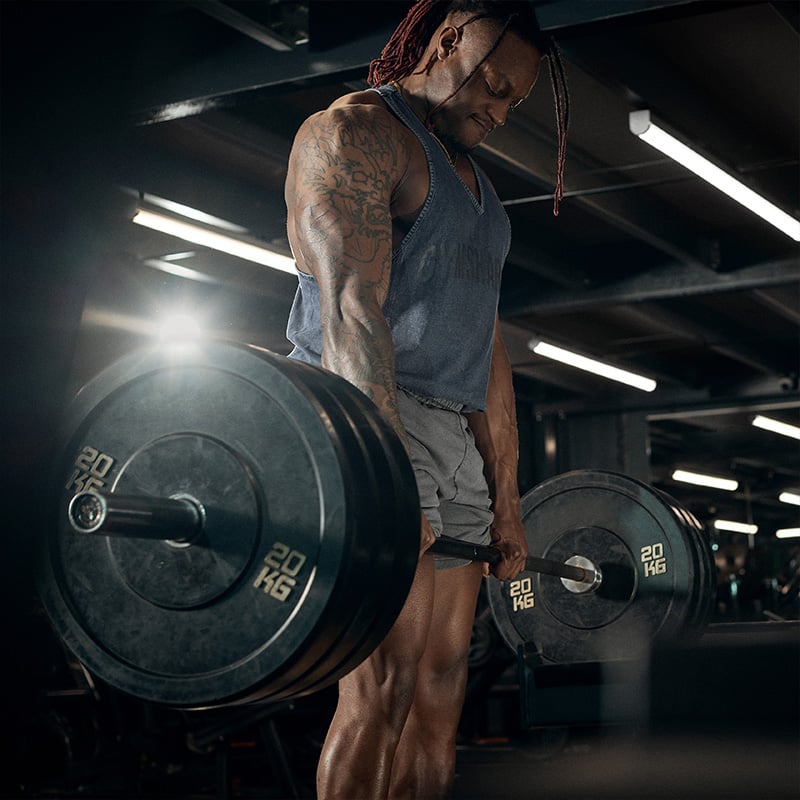
Large, sculpted quads you can show off in your gym shorts; a peachy behind that fills your scrunch bum leggings, and defined calves that scream athleticism; If that doesn’t convince you to train legs, then we don’t know what will.
But the best leg exercises don’t just make your legs look great. They also help you perform better in the gym, on the pitch, and in everyday life—from walking to tackling the stairs and carrying heavy objects.
But if training legs is so good, why do so many of us shy away at the mere mention of leg day?
Maybe it’s because leg workouts are so challenging – our leg muscles are some of the biggest muscles in our body, after all. But we know if you’re reading this, like us, you probably aren’t afraid of a little hard work!
So if difficulty isn’t the limiting factor, then maybe it’s simply not knowing which leg exercises to do, how often to train, and how to build effective leg workouts.
With so many differing opinions filling our feeds, the answer to the best leg exercises to grow big legs isn’t easy—but don’t worry, we’ve got the answers for you, with the best leg exercises to attack your hamstrings, quads, glutes, and calves.
Leg exercises can be pretty heavy work, especially when it comes to compound barbell exercises! Lifting accessories such as lifting straps and belts can help you push past those plateaus and help you reach that new PB.
Why Is It Important To Do Leg Workouts?
Leg day is no easy task. Leg workouts are one of the most physically demanding sessions of the week, and it takes hard work and determination to push yourself through the mental barriers to make progress.
It's easy to overlook leg day workouts in favor of other body parts, but leg exercises are essential for building a balanced physique. Training your leg muscles helps build muscular legs by producing elevated levels of cortisol and testosterone (the human growth hormone)—something chest day will thank you for, too.
Made up of the hamstrings, quads, glutes, and calves, your legs are home to some of the largest muscles in your body, and training them can help you burn calories, increase your metabolism, and build lean muscle.
Oh, and did we mention that leg exercises can help improve balance, coordination, and flexibility, reducing the chance of injury? Maybe it's time to take leg day more seriously…
Right, so you know why to train legs - it's now time to start choosing the best leg exercises for your next leg day workout.
As mentioned, the leg muscles comprise the hamstrings, quads, glutes, and calves. The best leg workouts target all four muscle groups, and the best leg exercises guide will show you how to do just that.
The 10 Best Leg Exercises
1. Romanian Deadlift
Primary Muscles Targeted: Hamstrings, Gluteus Maximus & Erector Spinae
Otherwise known as the Stiff-Legged Deadlift or RDL, the Romanian Deadlift is a fundamental exercise for both hamstring strength and the whole posterior chain, making it one of our best leg exercises.
It is a variation of the traditional deadlift that involves performing the movement from a standing position rather than lifting from the ground, focusing more on the hip hinge movement. Because of this, the RDL is considered crucial for developing proficiency in Olympic-style lifts (strengthening the hang position for cleans and snatches) and for developing lower-back and upper-hamstring development [1].
RDLs are usually performed using a bar or set of dumbbells, allowing plenty of volume to be put through the key muscle groups, which is essential for muscular development and conditioning.
How to Do the Romanian Deadlift:
Stand with feet hip-width apart, holding a barbell (or dumbbells) in front of your thighs with an overhand grip. Keep a slight bend in your knees.
Engage your core, pull your shoulder blades back, and maintain a neutral spine.
Push your hips back while lowering the weight down the front of your legs. Keep the bar close and your back straight.
Descend until you feel a stretch in your hamstrings—typically mid-shin level—without rounding your back.
Drive your hips forward to return to standing, squeezing your glutes at the top.
TIP: Your knees should be slightly bent during this movement, keeping your shoulders (scapula) retracted and your chest proud. Keeping your upper torso in a strict position, with arms working like hooks, will allow you to focus on the contraction in the muscle groups you're targeting.
2. Good Mornings
Primary Muscles Targeted: Hamstrings, Gluteus Maximus & Erector Spinae
Another posterior chain builder guaranteed to build strength in the hamstrings, glutes, and lower back [2]. Similarly to RDLs, good mornings involve a hip hinge movement pattern, but instead of holding the barbell in front of you, it’s typically loaded on the upper back, similar to a back squat.
Good mornings can also be performed using a resistance band (great for glute and hamstring activation during your leg workout warm-up), dumbbells or kettlebells, or a Smith machine (although some may find the latter's guided path reduces the natural hip hinge arch).
(FYI: If you’re looking to build your lower glutes, pair this exercise with RDLs for the ultimate underbutt activation 🍑)
How to Do Barbell Good Mornings:
Position the barbell on your upper traps (like a back squat), ensuring your feet are shoulder-width apart.
Engage your core, keep your chest up, and ensure your spine is neutral (not rounded).
Push your hips backward (not down), slightly bending your knees while keeping the barbell over your midfoot.
Lower your torso forward, keeping a neutral spine, until your upper body is nearly parallel to the floor or as far as you can go comfortably.
Drive through your heels, squeeze your glutes, and extend your hips to return to the starting position.
TIP: Only bring your torso forward as far as possible without your back rounding. If your back starts to round, don’t come so low.
3. Back Squats
Primary Muscles Targeted: Quadriceps, Hamstrings, Gluteus Maximus, Erector Spinae, Adductors, Core
The back squat is the king of leg exercises and deserves a place on our list of the best leg exercises. It is a functional exercise that will make you stronger in the gym, faster on the track, and better prepared for everyday tasks and activities [3].
This compound exercise is most commonly performed using a squat rack and barbell, with the weight across the upper back. The back squat unites many different training modalities and sports, a staple exercise in everything from bodybuilding to powerlifting and athletic training to sports performance.
How To Do Back Squats:
Position the barbell at shoulder height in a squat rack. Step under it, place it across your upper back (not your neck), and grip the bar slightly wider than shoulder-width.
Stand up to lift the bar off the rack. Step back, position your feet shoulder-width apart with toes slightly pointed out.
Take a deep breath, brace your core, and begin the squat by pushing your hips back, bending your knees, and keeping your chest up and back straight.
Lower until your thighs are parallel to the floor (or as deep as mobility allows) while keeping your heels flat.
Push through your heels to stand back up, extending your hips and knees. Exhale at the top and reset for the next rep.
TIP: If you’re new to squats, take time to master the bodyweight squat first. Focus on your form and learn the movement pattern before adding an external load, such as a kettlebell or dumbbell. When you feel confident moving onto the rack, you could try using a 10kg training bar initially to get used to the feeling of holding the weight on your back.
Suppose you’re already confident with back squats and are working to build leg strength and increase the weight you can squat. In that case, you might consider asking someone to spot you (particularly if you’re pushing out of your comfort zone and testing your one rep max) and using a lifting belt to increase intra-abdominal pressure for spinal support under heavy loads.
4. Front Squats
Primary Muscles Targeted: Quadriceps, Hamstrings, Gluteus Maximus & Core
When it comes to quad exercises, the front squat should be high on your list. It’s almost identical to a back squat, but the weight is loading on the front of the body, emphasizing the quads more and requiring greater core engagement and mobility.
Some lifters prefer front squats to back squats as they place less compressive force on the lower back and knee joint, promoting better posture and making them potentially safer for individuals with knee issues [4]. Either way, it’s a lower-body exercise not to be missed.
Just like the back squat, front squats can also be performed using dumbbells, kettlebells, or the Smith machine.
How To Do Front Squats:
Place the barbell on the front of your shoulders, resting on your deltoids, with elbows high and hands gripping the bar just outside shoulder width.
Stand with feet shoulder-width apart, toes slightly pointed out, and brace your core.
Push your hips back and bend your knees to lower your body, keeping your chest and elbows lifted.
Lower until your thighs parallel the floor, maintaining a straight, upright torso.
Push through your heels to stand back up, keeping your elbows up and core tight.
TIP: If you lack wrist flexibility for a traditional clean and press front squat grip, try the crossed arm approach: load the bar from a rack with hands resting on the opposite shoulder.
5. Bulgarian Split Squat
Primary Muscles Targeted: Quadriceps, Gluteus Maximus, Hamstrings & Adductors
The Bulgarian split squat is a powerful unilateral leg exercise you’ll likely love or hate! They are one of the best leg exercises for building the quads, glutes, and hamstrings, and you’ll find that even with lighter weights, they’re effective (making them well-suited for doing at home).
If you’re a regular runner or training for a Hyrox or a marathon, Bulgarian split squats are a good exercise to build single-leg strength and hip stability. They were found to be better than bilateral exercises in improving jumping ability, sprinting ability, and maximum leg strength [5].
How To Do Bulgarian Split Squats:
Stand a few feet in front of a bench or platform and place one foot behind you on it (top of foot or toes down).
Your front foot should be far enough forward so your knee stays over your ankle when you descend.
Keep your chest tall, shoulders back, and core engaged for balance and stability.
Bend your front knee to lower your body until your front thigh is roughly parallel to the ground. Keep the movement controlled.
Push through your front heel to return to standing, keeping your torso upright. Complete all reps before switching legs.
TIP: To emphasize your glutes more, lean forward slightly with your torso and focus on driving through the heel on your working leg as you stand back up. You could also elevate your front foot to increase the range of motion.
6. Hack Squat
Primary Muscles Targeted: Quadriceps, Gluteus Maximus, Hamstrings
Wondering how to get bigger thighs? The hack squat is one of the best quad exercises, typically performed on a hack squat machine, which loads the weight on the upper back and uses a sled that moves along a fixed track. The machine supports the spine while firing up the quads, offering a safe, stable environment for building strong legs.
The back support makes hack squats generally safer and easier to perform than back squats (making them suitable for beginners). It allows you to focus entirely on working the legs without heavily engaging the lower back or core for stability [6].
How To Do Hack Squats:
Load the hack squat machine and adjust the shoulder pads if necessary (they should sit just lower than shoulder height so that you can press the machine up).
Step onto the platform, placing your back against the backrest and your shoulders under the shoulder pads.
Position your feet on the platform, hip-width apart. Take hold of the handles located next to the shoulder pads. Push through your feet, fully extending your legs. Release the safety pins.
Start the movement: Slowly lower the weight, bending your knees until your thighs are parallel to the floor.
Pause, then reverse the movement, extending your legs and driving through your heels, until you return to the starting position. Ensure your knees do not lock out at the top.
TIP: Don’t have a hack squat machine? Many lifters use a Smith machine to do their hack squats if they don’t have access to a machine, placing their feet slightly forward to mimic a hack squat. Alternatively, you can also perform hack squat old-school style, holding a barbell behind your legs, or use a barbell in a landmine, holding the end at chest level.
7. Glute Bridge
Primary Muscles Targeted: Gluteus Maximus, Hamstrings, Adductors, Erector Spinae & Core
If you're dreaming of heavy squats and powerful deadlifts, the glute bridge is a must in any leg day routine. Often used as a leg workout warm-up or primer to ‘wake up’ the glutes before heavy lifts like squats, deadlifts, or lunges, glute bridges help prevent dominant muscles (e.g., quads, lower back) from taking over.
Using just your bodyweight, glute bridges are an ideal home workout leg exercise. By increasing time under tension or adding load (e.g., a resistance band or a dumbbell), glute bridges become a powerful posterior chain strength builder.
How To Do Glute Bridges:
Lie on your back with your knees bent, feet flat on the floor hip-width apart, and arms by your sides.
Brace your abs and flatten your lower back slightly to maintain a neutral spine.
Press through your heels to lift your hips off the floor until your body forms a straight line from shoulders to knees.
At the top of the movement,
squeeze your glutes
and pause for 1–2 seconds without overextending your lower back.
Slowly lower your hips to the floor and repeat for the desired reps.
TIP: Aim for your ankle to be directly below your knee to get the right angle. During the movement, push your heels into the ground and contract your hamstring and butt. Perform each rep in a controlled manner for maximum effect.
8. Hip Thrusts
Primary Muscles Targeted: Gluteus Maximus, Hamstrings, Adductors, Erector Spinae & Core
Another glute-building leg exercise that is a must in any leg day workout is hip thrusts. Hip thrusts use a greater range of motion compared to glute bridges, providing the ability to lift heavy loads, which equals maximum leg strength gains [7]!
While glute bridges are an ideal muscle activation, home workout, or beginner leg exercise, hip thrusts are better suited for intermediate to advanced lifters as a primary leg day exercise to target the glutes. If there’s any day to wear those scrunch butt leggings, it’s hip thrust day.
How To Do Hip Thrusts:
Sit on the floor with your upper back against a bench and roll a barbell over your hips (use a barbell pad for comfort).
Bend your knees so your feet are flat, hip-width apart, with your shins vertical at the top of the movement.
Tuck your chin slightly, engage your core, and keep your ribs down to avoid overextending your back.
Press through your heels and lift your hips toward the ceiling, squeezing your glutes at the top until your body forms a straight line from shoulders to knees.
Slowly lower your hips until your butt is just above the floor (not touching) and repeat for the desired reps.
TIP: If you feel hip thrusts in your lower back, it may be because your feet are in the wrong place. There isn’t a one-size-fits-all approach to foot placement for hip thrusts, so you’ll have to play around with what feels best for you.
A good starting point is to place your feet flat on the ground at shoulder width, with a slight flare of your toes for enhanced stability. It's essential to ensure that your knees track over your feet throughout the movement to avoid unnecessary joint strain.
9. Single-Leg Romanian Deadlift
Primary Muscles Targeted: Gluteus Maximus and Hamstrings.
When programming your leg workouts, it can be easy to focus on the big compound lifts such as squats, deadlifts, and hip thrusts. But ensuring your leg workout has unilateral exercises is crucial for a balanced physique and peak performance, and along with the Bulgarian split squat, the single-leg RDL is one of the best.
This lower-body exercise targets the posterior chain, especially the hamstrings and glutes. It involves balancing on one leg while hinging at the hips and lowering a weight (dumbbell, kettlebell, or barbell–although you can also perform these using just your bodyweight) toward the floor, with the non-working leg extending behind you for balance. This leg exercise will build stability, strength, and power throughout the posterior chain and core [8].
How To Do The Single-Leg Romanian Deadlift:
Stand tall on one leg with a slight bend in the knee, holding a dumbbell or kettlebell in the opposite hand (or no weight to start).
Slowly bend forward at the hips, keeping your back flat and chest up. Extend your free leg straight behind you for balance.
Lower the weight toward the floor, keeping it close to your standing leg, until you feel a stretch in your hamstrings or your torso is nearly parallel to the floor.
Drive your standing heel into the floor and squeeze your glutes to return to the upright starting position, keeping your hips level.
Perform the desired reps, then switch to the other leg and repeat.
TIP: Start with a light weight and focus on keeping your shoulders retracted throughout the exercise, controlling the movement slowly on the way down. Push your heel into the ground on the way back up, contracting your hamstrings and glutes to bring your torso back up to a vertical position.
10. Standing Calf Raise
Primary Muscles Targeted: Gastrocnemius & Soleus
Finally, it wouldn’t be a full leg workout without a calf exercise, our favorite being the standing calf raise. It involves lifting your heels off the ground while standing, moving the ankle joint through plantarflexion.
Start by performing this using only your body weight and focusing on high reps (4 sets of 25-30 reps). Experiment with toes pointed straight, inward, or outward to target different parts of the calf muscles. You can add dumbbells or kettlebells to increase the resistance as you get stronger.
The rep should be performed through a full range of movement. This means the calf should be fully stretched at the bottom of the rep and fully contracted at the top.
How To Do Standing Calf Raises:
Stand with your feet hip-width apart on a flat surface or elevated platform, toes pointing forward.
Keep your torso upright, brace your core, and maintain balance throughout the movement.
Push through the balls of your feet to raise your heels as high as possible, contracting your calf muscles at the top.
Hold the top position for 1–2 seconds, focusing on squeezing your calves.
Lower your heels back down with control, allowing a slight stretch in your calves before repeating.
TIP: Focus on mind-muscle connection, squeezing your calves at the top of the movement for maximum contraction and controlling the movement on the way down.
How To Plan & Structure Your Leg Workout
If you’re wondering how to grow your legs, then the key is to focus primarily on compound leg exercises during your leg day routine. These target multiple muscle groups at once under a greater load, for example, squats, deadlifts, and lunges.
Along with compound leg exercises, it's essential to consider the varied movement patterns across different planes of motion for a well-rounded leg workout. For example;
Extension - such as a squat or lunge variation.
Flexion - such as hamstring curls.
Hip Hinges - such as RDLs, or Deadlifts.
Plantarflexion - such as calf raises, or box jumps.
When planning your leg workout, including leg exercises incorporating the above movements can help build a baseline for your session, providing variety in the muscles targeted to boost strength, flexibility, and performance.
Progressive Overload
When planning your leg day routine, you should also emphasize progressive overload.
This means gradually increasing the weight and intensity of your exercises over time. It is best done through writing or using an app to track your sets, reps, and weight lifted.
Aim to add more weight or reps each week, and challenge yourself while retaining good form to ensure you're getting the most out of your leg workouts.
How To Warm Up Properly For Leg Day
Warming up for your full leg workout is essential to reducing your risk of injury and preparing your body for the challenge of leg day.
Elevating your heart rate is always a great place to start: Walking at a steady pace for 5 minutes on a cardio machine, such as a treadmill, bike, or assault bike, will help increase your heart rate and begin to circulate more blood around the body.
Next, move on to a few dynamic stretches before performing bodyweight leg exercises like squats, lunges, and calf raises.
Need some inspo? Try our Best Leg Day Warm Up Exercises.
When you come to start your main workout, ease yourself into the exercises by performing them using a light weight (or even a resistance band) for a reduced number of reps before increasing the weight and beginning your working set. This will help you get a better range of motion, activate your muscles, and prime your central nervous system.
How To Cool Down Properly After Leg Day
Starting with 5 minutes of low-intensity cardio at the start of your leg workouts will help to flush out lactic acid and improve circulation, reducing muscle soreness and improving recovery.
Following the low-intensity cardio, complete a few dynamic stretches before finishing with static stretches. Focus on stretching the muscles you just worked, hold each stretch for around 30 seconds, and focus on breathing for a deeper, more targeted stretch.
Try: The Best Hamstring Stretches For Tight Muscles
Try to target each major muscle group you have trained, along with your hips and back, with different static stretches while your muscles are warm and pliable.
FAQs
How Many Exercises Should I Choose For Leg Day?
This depends on your goal, program, and training experience. A beginner might choose 3 or 4 leg exercises for their leg workout. In contrast, someone more advanced could choose as many as 8 to 10 leg exercises, using a combination of supersets and trisets to program exercises back-to-back. According to research, the minimum effective dose for hypertrophy is around four sets per muscle group per week, with 5 to 10 sets per week being the more effective range for muscle growth [9].
Beginners might get away with less than this (thanks to ‘newbie gains’), but this research suggests you want to hit each muscle group with 1 to 3 exercises per week (based on the assumption you are doing 3 or 4 sets per exercise). You might split this across two focused leg days or spread your leg exercises out over multiple days, pairing them with upper body exercise or cardio.
How Many Leg Days Should I Do A Week?
If growing strong legs is your goal, you should aim to train them two to three times per week. This will give you enough time to recover between leg workouts and allow your muscles to adapt and grow.
Muscles generally need 48 hours to recover, so it's vital to avoid back-to-back leg workouts that place increased stress on the same muscle groups. This ensures adequate rest, recovery, and muscle growth.
Before deciding on what leg day split works best for you, consider your goals—if your lower body is a weakness or priority, you may want to add an extra leg workout each week, and vice versa.
You can also split your leg workouts into separate days for hamstrings, quads, glutes, and calves. This will allow you to focus on specific muscle groups and ensure you get the most out of your leg workouts.
What Is The Most Effective Leg Exercise?
The best leg exercise will depend on your goals. However, compound exercises (those that engage several muscle groups at once) are invaluable for building overall leg size, strength, and balance. Squats are consistently regarded as one of the best compound lower body exercises, targeting the glutes, hamstrings, quadriceps, hip flexors, calves, and even the core. They are also a very versatile exercise, whereby different muscle groups can be emphasised to a different degree depending on your squat type [10].
In addition to squats, research has proved deadlifts (proven to produce similar lower body strength gains compared to squats [11]), step ups and hip thrusts to be very effective leg exercises–but the other exercises in this article will also be effective, as are isolation exercises for working specific muscle groups [12,13].
What Order Should I Do My Leg Exercises In?
The best leg workouts start with compound exercises followed by isolation exercises. Compound exercises that involve multiple muscle groups require lots of energy, so it is best to do them at the start of your workout. This will not only help you perform them with better form, reducing the chance of injury, but also help you lift heavier and maximize gains.
Can I Train Leg Exercises At Home?
Yes! Leg workouts don’t always need to include a heavy barbell or squat rack. Many leg exercises can be performed using dumbbells (e.g., goblet squats, RDLs, and glute bridges). Even if you don’t have weights, you can still perform many bodyweight leg exercises and purchasing a resistance band is a convenient and cheap way to add some load to your leg exercises at home.
Time To Train Your Legs With The Best Leg Workout
Looking to get stronger, more muscular legs? Using the best leg exercises (as mentioned above) to target each and every leg muscle is essential. Not only will it help you build an athletic physique, but it will also increase your strength, power, and overall health and fitness. When designing your leg workouts, focus on compound exercises and progressive overload. Aim to perform them two to three times per week, and always warm up and cool down properly.
References:
Frounfelter, G. (2000). Teaching the Romanian Deadlift. Strength and Conditioning Journal, 22(2), p.55.
Ross, S., Comfort, P. and McMahon, J. (2022). The Good Morning—Exercise Technique and Exercise Selection Principles. Strength & Conditioning Journal, [online] p.10.
Zuna, I.-A. (2024). The Benefits of Kneeflexions (Squats) on Body Health. Romanian Journal of Medical Rehabilitation Physical Medicine and Balneoclimatology, 1(1), pp.75–7
Gullett, J.C., Tillman, M.D., Gutierrez, G.M. and Chow, J.W. (2009). A Biomechanical Comparison of Back and Front Squats in Healthy Trained Individuals.
Zhang, W., Chen, X., Xu, K., Xie, H., Li, D., Ding, S. and Sun, J. (2023). Effect of unilateral training and bilateral training on physical performance: A meta-analysis. Frontiers in Physiology, [online] 14(1).
Clark, D.R., Lambert, M.I. and Hunter, A.M. (2017). Trunk muscle activation in the back and hack squat at the same relative loads. Journal of Strength and Conditioning Research, p.1.
Kim, D., Jung, J. and Chung, Y. (2021). The Effects of Performing Bridge Exercise and Hip Thrust Exercise using Various Knee Joint Angles on Trunk and Lower Body Muscle Activation in Healthy Subjects. Physical therapy rehabilitation science, 10(2), pp.205–211.
Weaver, A.N. and Kerksick, C.M. (2017). Implementing Landmine Single-Leg Romanian Deadlift into an Athleteʼs Training Program. Strength and Conditioning Journal, 39(1), pp.85–90.9.
C.Pelland, J., F.Remmert, J. and P.Robinson, Z. (2024). View of The Resistance Training Dose-Response: Meta-Regressions Exploring the Effects of Weekly Volume and Frequency on Muscle Hypertrophy and Strength Gain.
Coratella, G., Tornatore, G., Caccavale, F., Longo, S., Esposito, F. and Cè, E. (2021). The Activation of Gluteal, Thigh, and Lower Back Muscles in Different Squat Variations Performed by Competitive Bodybuilders: Implications for Resistance Training.
Coratella, G., Tornatore, G., Caccavale, F., Longo, S., Esposito, F. and Cè, E. (2021). The Activation of Gluteal, Thigh, and Lower Back Muscles in Different Squat Variations Performed by Competitive Bodybuilders: Implications for Resistance Training.
Neto, W.K., Soares, E.G., Vieira, T.L., Aguiar, R., Chola, T.A., Sampaio, V. de L. and Gama, E.F. (2020). Gluteus Maximus Activation during Common Strength and Hypertrophy Exercises: A Systematic Review.
Neto, W.K., Vieira, T.L. and Gama, E.F. (2019). Barbell Hip Thrust, Muscular Activation and Performance: A Systematic Review.