



















Classes like HIIT are measured by intensity; it’s in the name. But most strength training plans are built around numbers. Recording the weight you're lifting, the number of sets and reps, pace, and HR zone are all extremely useful tools for tracking and progressive overload, but they don't always reflect how your body is actually responding on the day.
That’s where RPE (Rating of Perceived Exertion) comes in. RPE bridges the gap between how hard you’re actually working and how hard the workout feels. It strips things back and considers things like your breathing rate, how fatigued your muscles feel, and your overall sense of effort.
No tech, no formulas, just a more intuitive way to train that helps you recognise when to push and when to ease off. Too much intensity too often can increase injury risk and stall progress, while not enough means you’re leaving results on the table.
In this article, we’ll break down the Borg Scale of RPE and how to use it across both strength training and cardio, so you can better understand what your body is telling you mid-session.
What Is RPE?
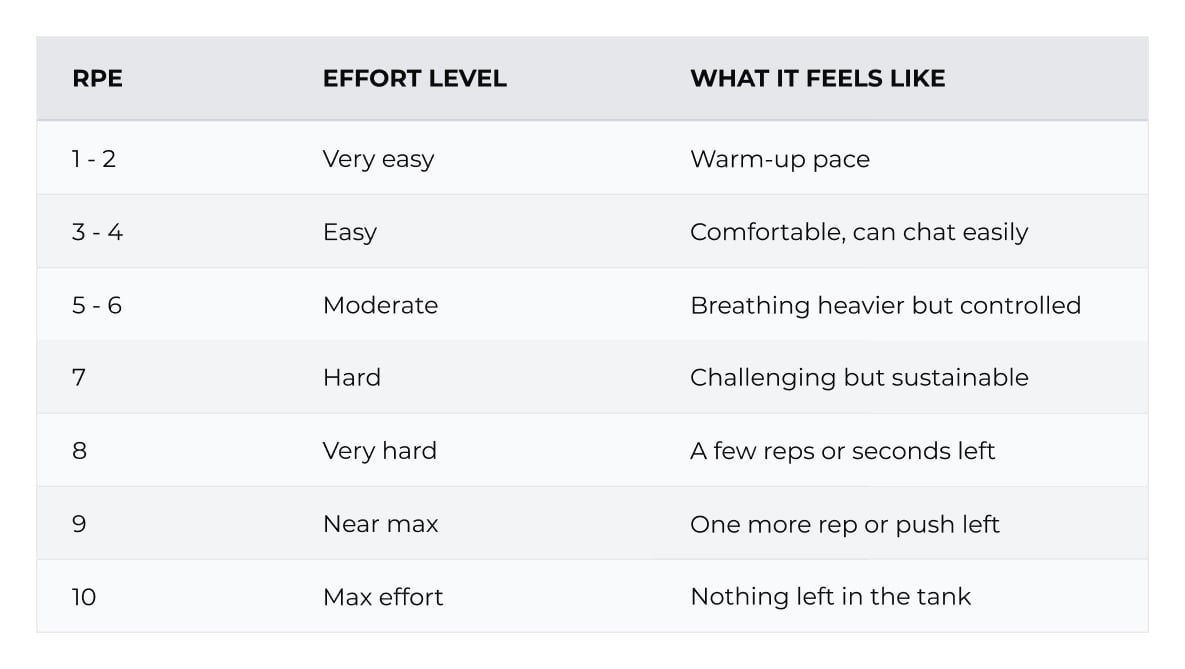
RPE stands for Rating of Perceived Exertion, and it’s a scale used to measure how hard exercise feels during a set, a run, or a whole session. At the lowest end, something like a warm-up or light mobility work would sit around an RPE 1.
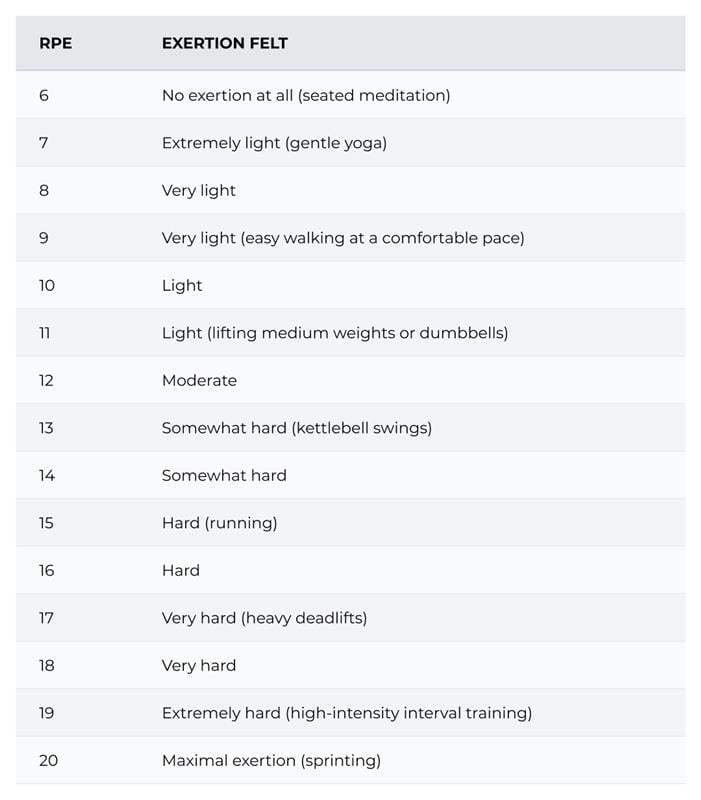
The version most people use today is adapted from the Borg Rating of Perceived Exertion Scale, developed by Gunnar Borg in 1982 [1]. Originally, Borg created a 6–20 scale, designed to roughly match heart rate, so an RPE of 13 would correlate to a heart rate of around 130 bpm. Research has consistently shown that perceived exertion lines up closely with physiological markers like heart rate and oxygen uptake, which is why it holds up surprisingly well even without any equipment [2].
Over time, this scale was simplified into the 1–10 scale you’ll see in most gyms and training plans today. Instead of linking directly to heart rate, this version focuses more on how your breathing and effort feel (from controlled deep breathing to shortened breath), making it quicker to use mid-workout.
When you rate your RPE, you’re combining multiple signals and sensations at once. Your breathing rate, the burn in your muscles (lactic acid build-up), how heavy something feels, and how close you are to your limit all feed into that number.
Why RPE Is Useful In Training
RPE is valuable because it uses real-world measures that everyone can understand and adapts to the changes your body experiences every day.
Your performance isn’t the same every day. Sleep, stress, nutrition, and even something as simple as a long commute can drain your energy and change how a workout feels. Fixed numbers don’t account for that, but RPE does.
Instead of forcing a specific load or pace, you match the effort to your current capacity. That makes it easier to manage fatigue, stay consistent, and avoid that cycle of pushing too hard followed by needing time off.
It also removes the barrier of needing tech. Whether you’re in a fully equipped gym or out running without a watch, you can still train with intent.
The Original Borg Scale:
The original Borg Rating of Perceived Exertion Scale runs from 6 to 20, with each number representing how hard an activity feels. This scale was designed to mirror heart rate, which is why the numbers don’t start at 1. While it’s still used in research and clinical settings, it’s less practical for everyday training.
The Modern Borg (RPE) Scale:
The scale most commonly used in training today is a modified 1–10 version of the original Borg scale. It’s designed to make judging effort more intuitive during workouts. At the lower end, effort feels light and sustainable. As intensity increases, breathing becomes more laboured, muscles fatigue more quickly, and your ability to continue drops off.
For cardio, this often comes down to how easily you can talk. For strength training, it’s more about how close you are to failure and whether you could perform additional reps with good form.
Even though the modern version is simplified, it still reflects the same underlying idea as Borg’s original work: your perception of effort is a reliable indicator of how hard your body is working.
RPE vs Reps in Reserve (RIR)
Alongside RPE, you’ll often see Reps in Reserve (RIR) used in strength training programmes. While RPE asks, “How hard did that feel?”, RIR asks, “How many reps did I have left?”
These two concepts are closely linked. If you finish a set and feel like you could complete two more reps, you’re likely around an RPE 8. One rep left would be closer to RPE 9, while no reps left would be RPE 10. RPE 10 also relates to what you’ve likely heard of as “working till failure”.
Some people find RIR easier to visualise, especially when they’re newer to training, while RPE can feel more intuitive over time. Many training programmes use both together to give a clear idea of effort and fatigue.
How To Use RPE For Strength Training
You can use RPE in strength training to adjust the load based on how you feel, based on the 1-10 scale, and manage effort across your sets.
Rather than sticking rigidly to a number on the bar, you’re working within an effort range. That means the weight might change slightly from session to session, but the level of challenge stays consistent.
For example, if your programme calls for:
3 sets × 8 reps @ RPE 7
You’re aiming to finish each set feeling like you could still complete around two or three more reps. So here, you’d choose a weight that allows you to complete each set while still having around two to three reps left in reserve.
On a day when you’re well rested and feeling strong, that might mean lifting slightly heavier. If you’re fatigued, distracted, or training in a lower energy part of your menstrual cycle, you might go lighter to hit the same effort level.
The flexibility of RPE allows you to keep having effective workouts without forcing performance when your body isn’t fully recovered. Over time, this approach helps you build a better understanding of your own limits. You’ll start to recognise what a true “hard but controlled” set feels like versus something that’s pushing you too close to failure too often.
While training to failure works for the principles of training for strength because it maximizes muscle growth, doing it constantly creates excessive fatigue, hinders recovery, and can lead to injuries or reduced performance.
It can also improve your mind-muscle connection. Because RPE requires you to pay attention to how a movement feels, not just whether you completed it, you become more aware of which muscles are actually doing the work. Instead of just moving weight from A to B, you’re tuning into tension, control, and fatigue within the target muscle.
This is especially useful for hypertrophy-focused training, where the quality of contraction matters just as much as the weight itself. If a set is supposed to feel like an RPE 7 but your target muscle isn’t fatiguing, it’s often a sign that the reps, set, or weight might need increasing. Using RPE in this sense also helps you refine your movements, not just your effort.
How To Use RPE For Cardio
RPE translates just as well to cardio, especially if you’ve ever felt like your pace or heart rate doesn’t quite match how hard a session actually feels. Instead of locking yourself into a specific speed, you use how intense the workout feels as your guide. This way, you’ll know when to slow down the pace to get back into the required intensity zone. A good example of this is when you’re running up a hill. If you keep the same pace you’ve been running on flat ground, your RPE is going to shoot up. Adjust your pace here to keep the effort consistent.
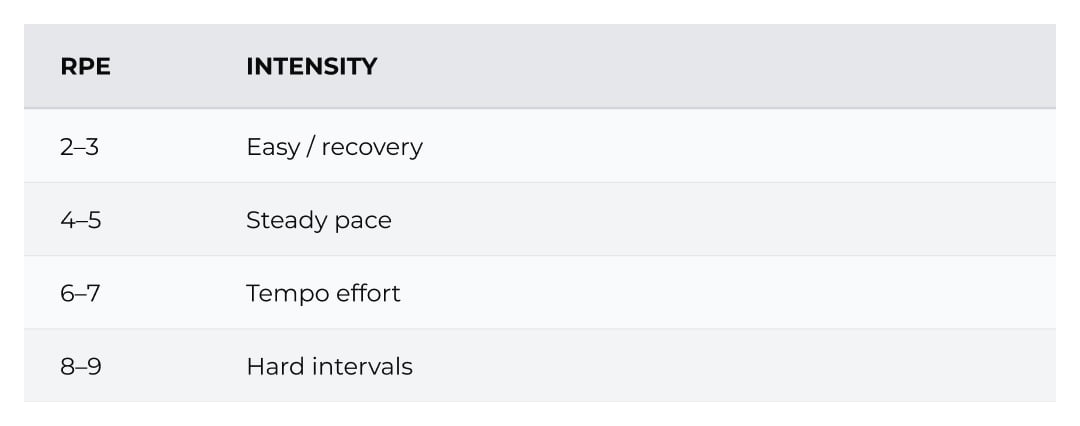
We tend to group intensity for running into zones. If you head out for a steady long run at RPE 4-5, you’re looking for a pace where your breathing is elevated but still controlled. You could hold a conversation, but it wouldn’t be effortless. Push up to RPE 7, and that conversation turns into shorter phrases. By the time you hit RPE 8 or 9, you wouldn’t be able to talk as you’re nearing your threshold effort.
And when running conditions aren’t ideal, or the run feels harder because of the heat, wind, hills, or fatigue, you can still work out how much effort you’re actually putting in without going off pace or heart rate and adjust to keep it consistent.
FAQs
Is RPE accurate for beginners?
Early on, it can be tricky to judge, especially if your body is not used to exercise and what exertion feels like. Beginners probably won’t know what true failure feels like or when and how to push themselves to that point, especially when everything feels challenging when you first start. Most people either play it too safe or go too hard, but the more you train and pay attention to how different efforts feel, the easier it becomes to assign the right number.
Is RPE better than heart rate training?
They serve different purposes. Heart rate gives you objective data, which is useful for structured training and tracking trends. RPE adds context, especially when your body isn’t responding in a predictable way, and gives a holistic and regulated look at training. Overall, RPE is considered better for learning to listen to your body and managing fatigue, but it does require experience to be accurate. Using HR training alongside it is a great way to get a look at the whole picture.
Can you use RPE for running?
Yes, it’s a highly effective tool for running, and one many runners rely on to measure how hard their run feels on a scale of 1 - 10. It’s particularly helpful for pacing long runs as it allows runners to adapt the effort of their runs to changing conditions like heat, terrain, or fatigue.
What does RPE 7 feel like?
RPE 7 should feel like a challenging but controlled effort. You’re working, but not straining. In the gym, you’d have a couple of reps left at best. On a run, you could speak in short bursts but wouldn’t want to hold a full conversation.
Should every set be high RPE?
If you’re maxxing out constantly, you’re going to find it difficult to train consistently. Spending too much time at the top end of the scale can quickly build fatigue and impact recovery. Most sessions should sit somewhere in the middle, around RPE 7-8.5 or 1-3 RIR. Higher efforts should be used more strategically to challenge yourself in heavy strength work.